
AIF VALUE LIFECYCLE

From AI opportunity to outcomes

AIF connects AI opportunities, investment decisions, execution, and outcome realization in one continuous lifecycle.

Start with a new idea or bring existing work into the stage that matches its maturity.

THE AIF LIFECYCLE

One use case connected from idea to outcome

Each stage carries the use case’s business intent, ownership, and success measures forward. Decisions shape the next commitment, while working proof addresses uncertainty where needed.

Jump to a stage or phase

01 ·AI Idea

Glowing lightbulb beside a hypothesis document, representing an initial AI idea.
Stage outcomeAn initial hypothesis

Start with where AI could change the work

Turn a business need into a defined work problem, with an initial owner and a clear reason to investigate AI.

Evidence added
Workflow friction, initial owner, and intended change.
Next decision
Is this worth investigating as an AI use case?
Explore stage detail: AI IdeaHide stage detail: AI Idea

An AI Idea begins with a business need, workflow problem, performance opportunity, customer or employee experience, risk, or strategic priority—not with a technology looking for somewhere to land.

The objective is not yet a business case. It is to make the opportunity concrete enough to ask whether AI could create a meaningful change in the work.

Technology powers the how. Business logic decides what matters.

Ambiguity reduced
Technology-first speculation and unclear purpose.

02 ·AI Concept

Layered feasibility and business value panels joined by a glowing decision point.
Stage outcomeAn owned use case + value hypothesis

Connect the change in the work to intended business value

Give the idea an accountable owner, workflow context, a value hypothesis, and initial success measures.

Evidence added
AI-enabled change, contribution, data context, and success signal.
Next decision
Is the intended contribution clear enough to assess feasibility and investment?
Explore stage detail: AI ConceptHide stage detail: AI Concept

Time released, better quality, faster processing, improved decisions, greater consistency, or higher throughput can all matter—but none is automatically business value.

AIF keeps the AI-enabled change distinct from how leadership intends to direct that change toward value.

AI changes the work. Leadership directs that change toward value.

Ambiguity reduced
The gap between an AI output and business value.

03 ·AI Opportunity

Value, investment, and financial panels combine targets, investment blocks, and outcome charts.
Stage outcomeA defensible case

Turn the concept into a decision-ready opportunity

Assess the business case and technical feasibility together, so the use case can be compared with other investment options.

Evidence added
Business relevance, AI suitability, readiness, risk, and investment context.
Next decision
Is the case strong enough to advance, or does a critical assumption need more evidence?
Explore stage detail: AI OpportunityHide stage detail: AI Opportunity

The business side considers workflow, strategic relevance, ownership, intended outcome, and investment posture. The technical side tests AI suitability, data, dependencies, complexity, architecture, integration, security, operability, and Scale readiness.

The purpose is not a score for its own sake. It is to make the next commitment more defensible.

Commitment should rise only as the evidence gets stronger.

Ambiguity reduced
Whether the case is credible on both sides of the decision.

AIF CAPABILITYOpportunity & Business Case connects use-case assessment, success measures, value logic, investment assumptions, and decision evidence.

04 ·AI Initiative

Planning panels connected by milestones and dependencies along a sequenced roadmap.
Stage outcomeA sequenced, committed plan

Put the qualified opportunity in portfolio context

A credible opportunity earns a place in a sequenced plan shaped by dependencies, capacity, timing, and trade-offs.

Evidence added
Dependencies, enabling work, timing, capacity, and sequencing.
Next decision
What moves now, next, later—or waits for an enabler?
Explore stage detail: AI InitiativeHide stage detail: AI Initiative

Use cases compete for the same data, architecture, engineering capacity, funding, change capacity, security attention, and executive bandwidth.

AIF makes those trade-offs visible so leadership can sequence the combination of opportunities that matters most.

Focus scarce resources on the combination of AI use cases that matters most.

Ambiguity reduced
Whether a good use case is the right priority now.

AIF CAPABILITYDynamic Roadmap helps leadership compare sequencing scenarios across opportunities, dependencies, capacity, and timing.

Proof of Concept

Phase of AI Initiative

A proof plan and performance curves beside a working AI agent executing a test and producing results.
Stage outcomeControlled working evidence

Use working AI when analysis cannot answer the next question

When an important uncertainty remains, the use case branches into the Applied AI Lab for the minimum credible working proof.

Evidence added
Working findings on the mechanism, data, integration, or workflow.
Next decision
Deepen proof, advance to Pilot, or stop.
Explore stage detail: PoCHide stage detail: PoC

A Proof of Concept is used when the core AI mechanism, data, architecture, integration, workflow fit, user interaction, technical performance, or another assumption cannot be resolved credibly through analysis alone.

The objective is not to industrialize the solution. It is to create the minimum working AI needed to answer the next progression question.

Use the Lab when uncertainty is important enough to change the next decision.

Ambiguity reduced
Whether the proposed AI can work credibly enough to continue.

AIF CAPABILITYThe Applied AI Lab can be invoked here. Its working evidence returns to the same AIF use-case record.

Pilot

Phase of AI Initiative

Pilot evidence and performance charts beside a running AI app processing a user request and producing a response.
Stage outcomeEvidence in operating conditions

Validate the capability in the workflow—not just in the demo

Test the solution with real users and representative integrations, using the success measures defined in the original case.

Evidence added
Adoption, integration, workflow, performance, and outcome signals.
Next decision
Does operating evidence justify deployment, or should the workflow be refined or stopped?
Explore stage detail: PilotHide stage detail: Pilot

The question is no longer simply whether the AI mechanism can work. The Pilot tests whether the capability creates the intended change in the work, whether people use it, and whether the surrounding process and technology can support it.

A successful PoC is evidence for a Pilot. A successful Pilot is evidence for Scale. Neither is the same as attained business value.

Proof, validation, and industrialization are different commitments.

Ambiguity reduced
Whether the capability works in practice—not only in isolation.

AIF CAPABILITYOutcome Realization begins carrying baselines, targets, technical findings, proof evidence, adoption signals, and actual results forward.

05 ·AI Deployment

Operating evidence supported by performance charts and a readiness check.
Stage outcomeA supported operating capability

Prepare the capability for sustained operation

A proven capability is prepared for production ownership, controls, integration, enablement, and sustained measurement.

Evidence added
Ownership, controls, support, integration, rollout, and measurement readiness.
Next decision
Is the organization ready to deploy, operate, and scale responsibly?
Explore stage detail: AI DeploymentHide stage detail: AI Deployment

AI Deployment turns Pilot evidence into an explicit operating commitment. The work shifts from proving the capability to establishing production ownership, controls, integration, support, enablement, and measurement.

The deployment decision makes responsibilities and readiness gaps visible before broader Scale increases reach, investment, or operational exposure.

Production begins with clear ownership—not simply a successful Pilot.

Ambiguity reduced
What must be true before production responsibility begins.

AIF CAPABILITYOutcome Realization carries the original case and Pilot evidence into production readiness so deployment decisions remain connected to intended value.

Scale

Phase of AI Deployment

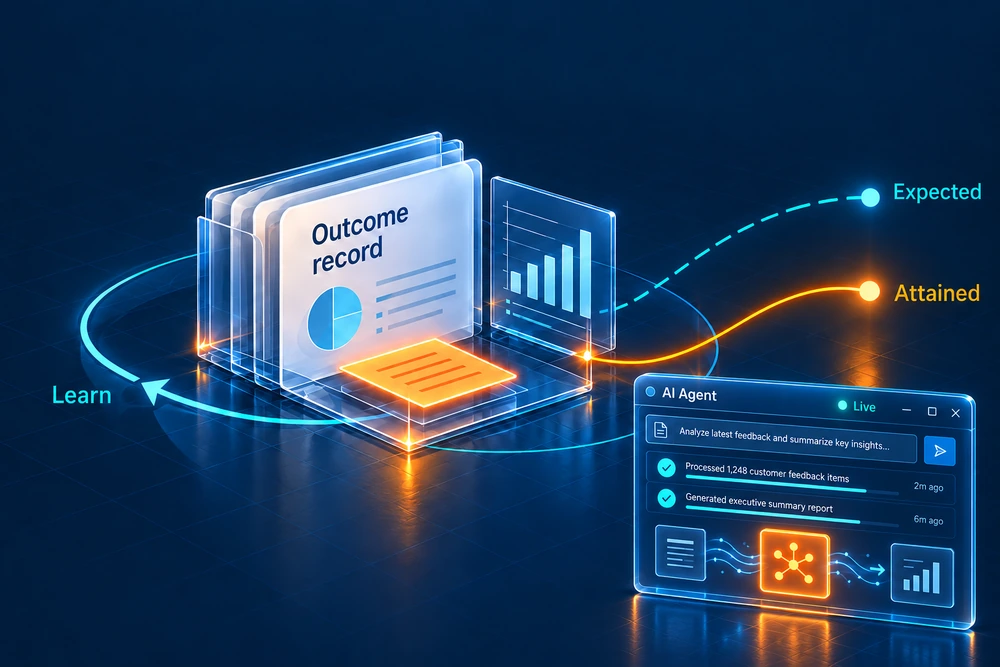
An outcome record compares expected and attained results, with a learning loop and a live AI agent completing tasks.
Stage outcomeOutcomes inform the next decision

Extend the capability — track whether the intended value is realized

Extend the deployed capability while measuring actual business outcomes against the original case. The client or its production partner owns ongoing operation.

Evidence added
Operating performance, actual outcomes, ownership, and support signals.
Next decision
Reinforce, adjust, extend, scale further, stop, or reprioritize.
Explore stage detail: ScaleHide stage detail: Scale

Production ownership, security, monitoring, support, permissions, integrations, user enablement, model or agent behavior, and sustained measurement become operating responsibilities of the client or its chosen production partner.

AIF keeps the intended outcome, KPI logic, investment assumptions, technical findings, roadmap context, and progression history connected through operation.

Proof should make production ownership clearer—not create dependency.

Ambiguity reduced
Whether expected value is actually being attained.

AIF CAPABILITYOutcome Realization compares the original expectation with what is actually being attained. Validator carries that logic through PoC, Pilot, and Scale.

VALIDATE, LEARN, REPRIORITIZE

Validate outcomes — improve what comes next

Compare expected and attained outcomes, then carry what the work revealed into the next opportunity.

Update value assumptions, adoption plans, and portfolio priorities so each initiative improves the decisions that follow.

GOVERNANCE THROUGHOUT THE LIFECYCLE

Clear ownership at every commitment

The use-case owner remains accountable for the business outcome as work moves through the lifecycle. Business, technical, financial, and delivery teams contribute to the decisions that shape the next commitment.

Leadership authorizes the next commitment. The accountable owner, decision, rationale, and conditions for further investment stay with the use-case record.

Illustration of three leaders reviewing a shared use-case evidence record, with cyan charts and an orange decision marker.
Concept illustration of two business leaders reviewing six progressively larger architectural models illuminated in cyan and orange.

PUT AIF INTO PRACTICE

Put the AIF lifecycle to work

Explore how AIF can guide your current and planned AI work from opportunity through portfolio decisions, working proof, deployment, and measurable business outcomes.

Talk to Trebor

PRIVACY CONTROL

Privacy Choices

Trebor does not currently use analytics, advertising, or cross-site tracking cookies or similar technologies on this website.

No optional cookies or trackers are currently active.